Category: ETP Field Guide

  • 1.2.1 Pumps, Blowers, and Dosing Systems

    বাংলায় পড়ুন

    When a plant reading changes, start by checking what the equipment actually delivers. Keep a simple asset record with the tag, required duty, normal readings, standby arrangement, and operating manual. A baseline taken under known conditions gives each new reading something useful to compare with.
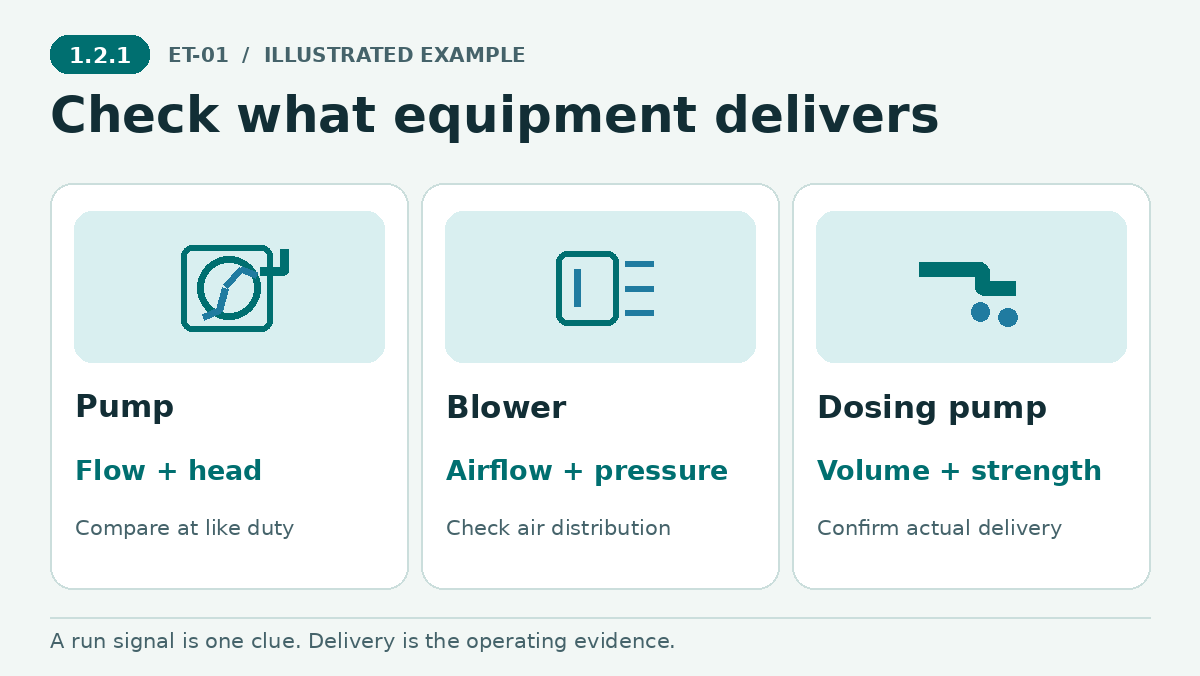
    A pump, blower, and dosing pump with the measurements used to verify what each delivers.
    Read flow with head, airflow with pressure, and dosing volume with solution strength.

    Three pieces of evidence

    • Transfer pump. Compare flow and differential head at comparable duty. If flow falls, check meter validity, the lineup, suction conditions, and any other clues such as noise, vibration, or current.
    • Blower. Look at delivered airflow, header pressure, and distribution together. Higher pressure with lower airflow can point toward a restriction, but confirm what changed in the air system before naming a fault.
    • Dosing pump. Check the delivery rate and solution strength using the authorized test and chemical-handling procedure. The quantity of active chemical depends on both.

    Build a useful trend

    Record operating conditions alongside each reading. Compare a blower at the same speed and similar air-system settings. Compare a pump at similar head. Plan the check interval from the manufacturer’s guidance, operating risk, and service history. Include a representative standby test in the site plan. A measured change over several comparable rounds gives maintenance a clearer starting point than an isolated alarm.

    Further reading · U.S. Department of Energy pumping systems guide

    ‹ Previous lesson · Chapter contents · Next lesson ›

  • ১.১.১ ট্রিটমেন্ট ফ্লো ও ইউনিটের কাজ

    Read in English

    এফ্লুয়েন্ট ট্রিটমেন্ট প্লান্টের (ইটিপি) ইনলেট থেকে পানির পথ ধরে এগিয়ে যান। প্রতিটি ইউনিটে দেখুন, পানির কী বদল হচ্ছে আর আলাদা করা পদার্থ কোথায় যাচ্ছে। এই দুটি প্রশ্নের উত্তর পেলে প্লান্টের বিন্যাস বোঝা সহজ হয়।

    ১০ সেকেন্ডের অ্যানিমেশন। ছয়টি ধাপে পানি কোথায় যায় দেখুন। নিচের তিরগুলো রিটার্ন ও ওয়েস্ট স্লাজের পথ দেখায়।

    স্ক্রিন থেকে আউটলেট

    • স্ক্রিন ও ইকুয়ালাইজেশন (EQ)। স্ক্রিন বড় কণা আটকায়। EQ ট্যাংক পরের ট্রিটমেন্ট ধাপে যাওয়ার আগে ফ্লো ও কনসেনট্রেশনের ওঠানামা সামলায়।
    • কেমিক্যাল ট্রিটমেন্ট। প্রসেসের প্রয়োজন অনুযায়ী pH কন্ডিশনিং ও কোয়াগুলেশন দিয়ে কণাগুলোকে একত্র হওয়ার উপযোগী করা হয়। ফ্লকুলেশনে বড় ফ্লক তৈরি হয় এবং প্রাইমারি ক্ল্যারিফায়ারে স্লাজ আলাদা হয়।
    • বায়োলজিক্যাল ট্রিটমেন্ট। প্রচলিত অ্যাক্টিভেটেড স্লাজ প্রসেসে এয়ারেশন মাইক্রোঅর্গানিজমের জন্য অক্সিজেন সরবরাহ করে। সেকেন্ডারি ক্ল্যারিফায়ার ট্রিটেড পানি থেকে বায়োমাস আলাদা করে।
    • পলিশিং ও রিলিজ। ডিজাইন অনুযায়ী ফিল্টার বা অন্য পলিশিং ইউনিট অবশিষ্ট দূষক কমায়। ফাইনাল চেকের জন্য নির্ধারিত স্যাম্পল পয়েন্ট ও অনুমোদিত ডিসচার্জ বা রিইউজ রুট দেখুন।

    সলিডসের পথও দেখুন

    কাল্পনিক টেক্সটাইল প্লান্ট ET-01-এ সেকেন্ডারি ক্ল্যারিফায়ার থেকে রিটার্ন অ্যাক্টিভেটেড স্লাজ (RAS) এয়ারেশনে ফেরে। ওয়েস্ট অ্যাক্টিভেটেড স্লাজ (WAS) স্লাজ হ্যান্ডলিংয়ে যায়। প্রাইমারি স্লাজের জন্য আলাদা নির্ধারিত রুট আছে। সিকোয়েন্সিং ব্যাচ রিঅ্যাক্টরে নির্দিষ্ট সময়ের ধাপে রিঅ্যাকশন ও সেটলিং হয়। মেমব্রেন বায়োরিঅ্যাক্টরে মেমব্রেন সলিডস আলাদা করে। যেকোনো বিন্যাস বোঝার জন্য সলিডসের গন্তব্য খুঁজুন।

    আরও পড়ুন · IFC টেক্সটাইল ওয়েস্টওয়াটার গাইডলাইন

    অধ্যায়ের সূচি · পরের লেসন ›

  • 1.1.1 Treatment Flow and Unit Functions

    বাংলায় পড়ুন

    Stand by the inlet of an effluent treatment plant (ETP) and follow the water. At each unit, ask what the unit changes and where the material it removes goes. That simple walk makes the rest of the plant easier to understand.

    10-second illustration. Follow the water through six stages. The lower arrows trace return and waste sludge.

    From the screen to the outlet

    • Screen and equalization (EQ). The screen catches coarse material. The EQ tank buffers swings in flow and strength before downstream treatment.
    • Chemical treatment. Where the process calls for it, pH conditioning and coagulation help destabilize particles. Gentle flocculation builds larger flocs, and the primary clarifier separates the resulting sludge.
    • Biological treatment. Aeration supplies oxygen for microorganisms in a conventional activated sludge process. The secondary clarifier separates biomass from the treated water.
    • Polishing and release. A filter or another polishing unit can remove remaining contaminants as designed. The designated sampling point and authorized outlet or reuse route define where the final checks belong.

    Follow the solids, too

    In the fictional textile plant ET-01, the secondary clarifier sends return activated sludge (RAS) back to aeration. Waste activated sludge (WAS) leaves the biological loop for sludge handling. Primary sludge follows its own designated route. In a sequencing batch reactor, reaction and settling take place in timed stages. In a membrane bioreactor, membranes separate solids. Finding the solids path is a useful way to read any of these layouts.

    Further reading · IFC textile wastewater guidance

    Chapter contents · Next lesson ›