For an apartment building, the solar decision starts with the common-service meter. Lifts, water pumps, corridor lighting, and outdoor lighting operate at different times. A monthly bill can show their combined energy use, but it cannot show how much demand coincides with sunshine.
I revisited a residential solar feasibility case with three towers and six lifts. Its most useful lesson is the need to separate daytime energy savings, grid export, and backup power before comparing quotations.
Audit the existing system first
If panels are already on the roof, record what they deliver before buying additional equipment. Check the meter boundary, inverter generation, import and export registers, shading, and operating history. Log the common services over a representative period, ideally at intervals short enough to see lift and pump demand. Include weekdays, weekends, and expected seasonal changes.
Compare the three architectures
| Option | Main use | Evidence needed |
|---|---|---|
| Grid-connected PV | Uses solar alongside the grid and may export under the approved arrangement | Daytime demand, export eligibility, meter arrangement, and utility approval |
| Hybrid PV with battery | Adds a defined backup or time-shifting duty | Essential loads, required duration, usable storage, inverter power, and motor-starting behavior |
| PV with battery and no export | Serves approved loads within a controlled electrical arrangement | Load matching, battery duty, protection, and treatment of surplus energy |
A grid-connected system’s behavior during a grid outage depends on its approved design and protection. A battery system needs a specified backup circuit and operating mode. Verify the duty in the proposal and commissioning demonstration.
Keep kW and kWh separate
Kilowatts describe power. Kilowatt-hours describe energy over time. A 30 kWh battery label does not establish whether an inverter can start a lift motor, nor does it guarantee 30 kWh delivered at the load.
For an illustrative energy check, assume 30 kWh nominal storage, an 80% usable fraction, and 90% conversion efficiency. Delivered energy is approximately 30 × 0.80 × 0.90 = 21.6 kWh. At a steady 5 kW load, that is about 4.3 hours before allowing for further reserve or changing load. A lift system also needs a separate power, starting-current, control, and safety assessment.
Use a seasonal generation budget
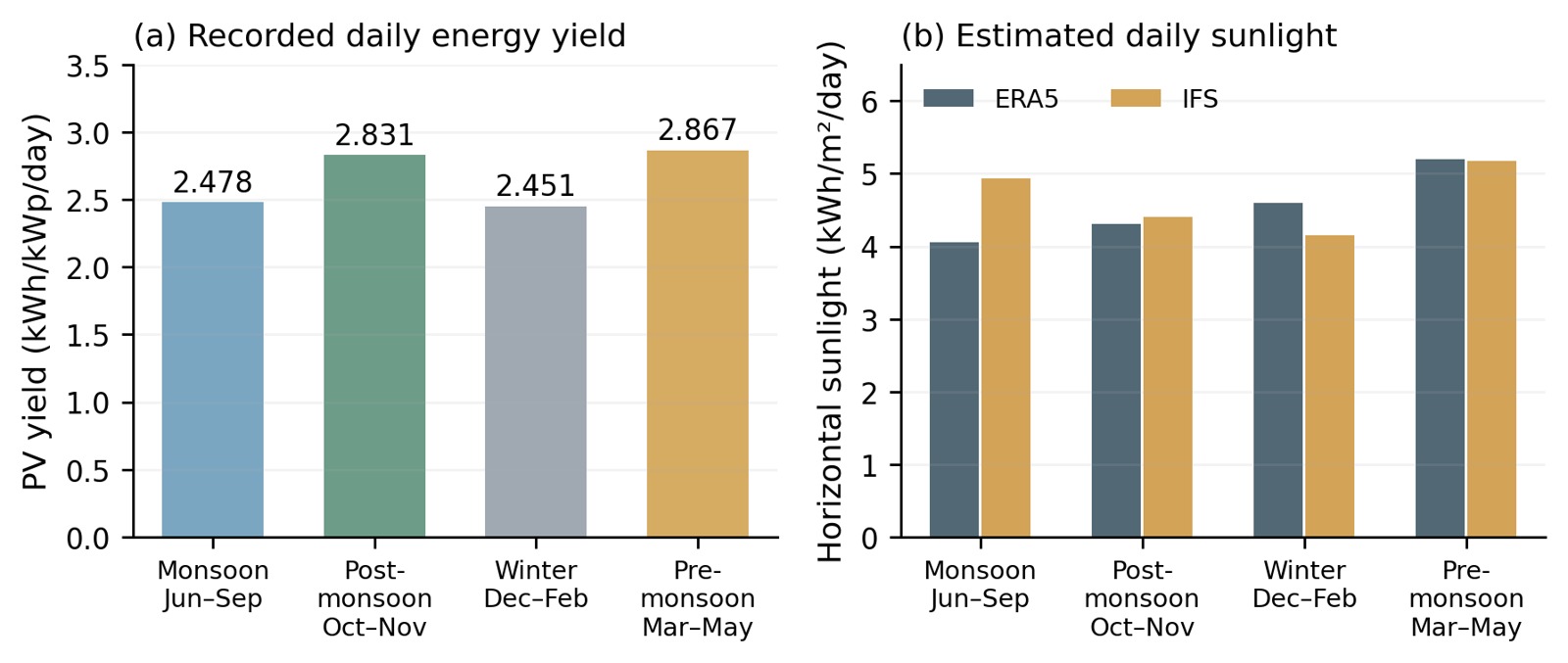
Estimate generation by month and compare it with demand in the same intervals. Self-consumed solar, exported solar, battery charging, and grid imports have different roles in the calculation. Use the applicable tariff and approved settlement arrangement for each energy stream.
Make quotations comparable
- Ask for a complete scope covering modules, inverters, batteries where applicable, structures, cabling, protection, metering, installation, approvals, testing, and maintenance.
- State the assumed monthly generation and the share expected to be used within the building.
- Show battery usable capacity, warranted duty, replacement assumptions, and the defined backup loads.
- Check roof structure, access, drainage, electrical protection, and motor compatibility with qualified specialists.
- Calculate payback from verified total cost and annual net savings, with operating and replacement costs visible.
The early feasibility note contains preliminary quotations and savings assumptions. The blog’s worked example explains the calculation method. A current purchase decision needs current scope, tariffs, demand records, and supplier commitments.
My practical view
Meter the building first, then buy the functions it needs. Grid-connected PV can address daytime energy. Storage earns its place when a measured backup or time-shifting requirement justifies it. Agree in advance how the team will demonstrate generation, import/export measurement, and the specified backup duty.
Official guidance
Use SREDA’s Net Metering Guideline 2025 and the Power Division’s net-metering information to check the current approval and metering process with the distribution utility.
Continue reading
Rooftop Solar Performance in Bangladesh · Diabari Waterlogging and Solid Waste Management · Practice Excel with plant data
Leave a Reply