A factory can buy sealed drinking-water jars, run a canteen tap and discharge dyehouse effluent at the same address. Each stream answers a different compliance question. Start with where the water goes, who uses it and what decision the test result will support.
Which BSTI standard fits the water?
Packaged drinking water. BSTI’s January 2025 catalogue lists BDS 1240:2021 for packaged drinking water other than natural mineral water, and BDS 1414:2021 for natural mineral water. Identify the product as sold, then check the current edition, amendments and applicable certification-mark requirements with BSTI. For purchased jars, match the producer and product on the licence to the label, delivery lot and supplier record.
Water at the canteen tap. Specify the supply source and actual point of consumption. A supplier’s jar certificate alone cannot answer a complaint about a tap fed from the roof tank. Check the applicable drinking-water requirements, storage and distribution, then sample the relevant tap under a documented protocol.
Water and wastewater services. BDS ISO 24512:2020 covers management and assessment of drinking-water utilities. BDS ISO 24511:2019 addresses wastewater utilities, including service management and assessment. BDS ISO 24521:2019 addresses basic on-site domestic wastewater services. A campus with shared sanitation can use service indicators such as interruptions, response to a complaint or desludging records alongside technical monitoring.
Where do textile effluent limits come from?
For a dyehouse outlet, identify the industry and discharge route under Bangladesh’s Environment Conservation Rules 2023 and check the factory’s environmental clearance conditions. The gazetted entry for textile washing, dyeing and printing includes pH 6–9, BOD₅ at 20 °C 30 mg/L, COD 200 mg/L, suspended solids 100 mg/L and colour 150 Hazen (Pt–Co). These are selected entries. Read the entire applicable row set, notes and permit. A tighter buyer target or a reuse specification should have its own column.
Recycling RO permeate. Agree an end-use specification with the process owner. Hardness, conductivity, colour and microbial indicators may matter differently for dyeing, cooling or toilet flushing. An outlet discharge result alone cannot establish suitability for drinking or for a particular recipe.
How to write a laboratory request you can defend
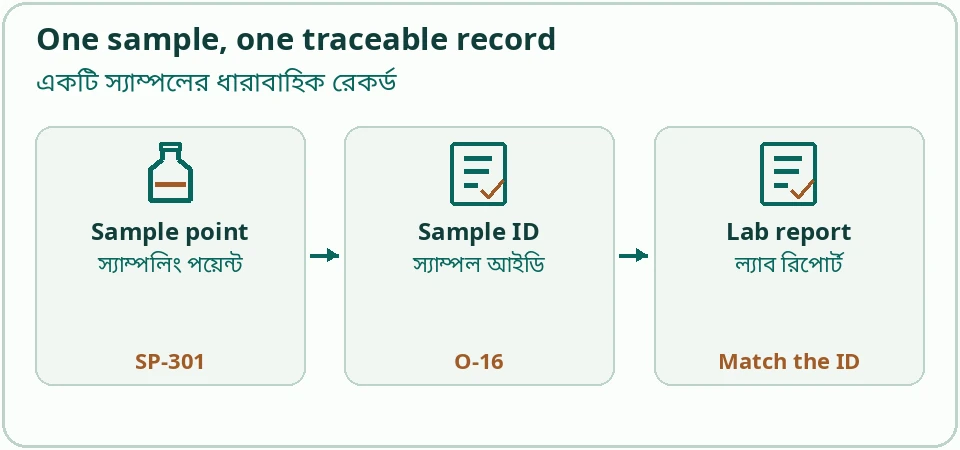
On one line per parameter, record the sample ID, matrix, point, intended use, required unit, limit source and edition, method and decision owner. Confirm the laboratory’s scope covers the parameter, method and matrix. Ask for the reporting limit when a low concentration matters. A result reported as “less than 1” cannot establish compliance with a limit of 0.5 in the same unit.
Source · Illustration · Arif Anwar’s Blog EPA wastewater sample collection procedure · Open full-size figure
For example, BDS ISO 6059:2022 describes EDTA titration for the sum of calcium and magnesium. BDS ISO 7393-2:2022 covers a DPD colour test for free and total chlorine. Select a method that fits the water matrix and the decision. The numerical acceptance limit comes from the applicable requirement.
Keep the signed report, chain of custody, applicable standard or licence, and any corrective action together. Record which requirements are statutory, contractual or internal. Update the register when a licence, permit, test method or standard changes.
Follow an outlet sample from the sampling point to the laboratory. The EPA operator training gives the plant context for the custody record.
Source · U.S. Environmental Protection Agency Original video
Download standards references and the Bangladesh gazette
BSTI publishes the catalogue and public previews below. The previews identify the scope and edition. Use the full authorized standard for a product certification or detailed conformity decision.
- BSTI agricultural and food standards catalogue · packaged waters, section 16 (PDF)
- BSTI catalogue of chemical standards · water-quality test methods (PDF)
- BSTI · BDS ISO 24511:2019, wastewater utility services (PDF preview)
- BSTI · BDS ISO 24521:2019, basic on-site domestic wastewater services (PDF preview)
- BSTI · BDS ISO 24512:2020, drinking-water utility services (PDF preview)
- Bangladesh Government · Environment Conservation Rules 2023, original Bangla gazette (PDF)
Related field guides
Water sampling and laboratory QA/QC · BNBC water and sewage budgets · Textile sustainability and ECR · 28 questions
Leave a Reply